

Would you like to switch to the accessible version of this site?

Go to accessible site Close modal window

Don't need the accessible version of this site?

Hide the accessibility button Close modal window
Accessibility View Close toolbar
Animal Advocates Veterinary Hospital

3899 Sonoma Blvd

Vallejo, CA 94589 US

707-552-1947

Open mobile navigation
  • Home
  • Contact Us
  • Clinic Hours
  • Services
  • New Patient Center
    • Online Forms
    • What to Expect
    • Virtual Office Tour
    • Veterinary Resources
    • Payment Options
  • Online Pharmacy
  • Pet Portal
  • Spay and Neuter
  • Veterinary Topics
    • Pet Health
      • Chronic Conditions
      • Digestive and Oral Health
      • Diseases and Viruses
      • Pests and Parasites
      • Orthopedics
    • Today's Veterinarian
    • Choosing Your Pet
      • Finding Your Pet
      • Cats
      • Dogs
      • Exotics
        • Amphibians
        • Birds
        • Reptiles
          • Lizards
          • Turtles
      • Small Mammals
        • Ferrets
        • Rabbits
        • Domesticated Animals
          • Prairie Dogs
        • Pocket Pets
          • Chinchillas
          • Guinea Pigs
          • Hamsters
          • Hedgehogs
          • Rats
      • Livestock
        • Cows
        • Donkeys, Horses & Mules
        • Goats
        • Pigs
        • Poultry
        • Sheep
    • Living With Your Pet
      • Bringing Your Pet Home
      • Children and Pets
      • Providing Care
      • Travel
      • Saying Goodbye
    • Newsletter Library
      • Cats
      • Tips for Pet Owners
      • Behavior & Training
      • Fleas & Parasites
      • Keeping Pets Healthy
      • Recognizing Illness
      • Nutrition & Food
      • Pet Dangers
      • Seasonal Topics
      • Visiting the Vet
      • Equine
      • Newsletter Archive
        • Fun with Pets
        • Unbelievable Pets
    • Video Newsroom
      • Health Topics
      • Technology and Science
      • Other Interests
    • Newsletter Library
    • Client Survey
    • Pets4Kids
  • Home >
  • Articles >
  • Choosing Your Pet >
  • Exotics >
  • Reptiles >
  • Lizards >
  • Leopard Geckos

Leopard Geckos

  • Created in Choosing Your Pet, Exotics, Reptiles, Lizards

leopard gecko

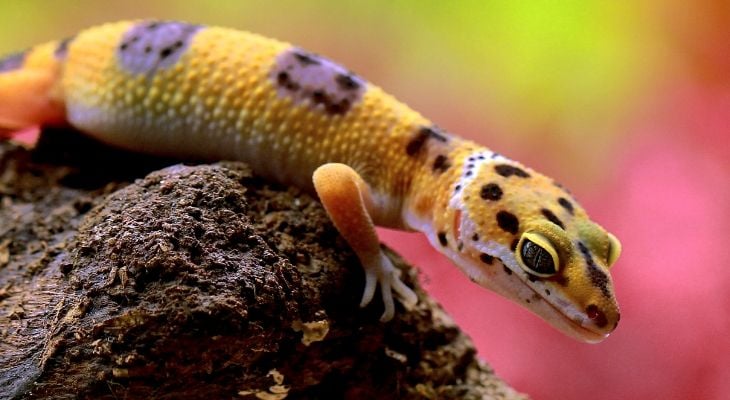
The scientific name for leopard gekos is Eublepharis Macularius. They may live 20 or more years and grow to be approximately 8-10 inches long. Their common coloring is yellow and white with black spots (hatchlings start out striped, and gradually change to the spotted appearance). There are several color (e.g. high yellow, leucistic and pattern (e.g. jungle, striped) variations. Leopard gekos are nocturnal, ground dwelling, and generally docile and easy to tame. They do not have the toe pads like other geckos so do not climb very well. They do have eyelids, also unlike other geckos.

Housing

A 15-20 gallon tank is large enough for 2-3 geckos, but there should only be one male per tank (and only keep males and females together if prepared to deal with offspring!). Half logs provide hiding and climbing space, as can commercial reptile caves and simple cardboard boxes. A damp hide box can help with shedding (a plastic container with a hole in the lid, with moist soil or moss inside).

Young geckos shouldn't be kept on sand, as they may ingest it and get a blockage. Paper is absorbent and easy to change, and indoor outdoor carpet works well too. Avoid wood shavings. Whatever is used, make sure it is not being ingested along with the gecko's meals.

Light and Heat

Being nocturnal, leopard geckos require no special UV lighting. A regular incandescent bulb could be used to provide a basking spot, but leopard geckos probably prefer dimmer conditions so consider using a red bulb or ceramic heating element to provide the temperature gradient. Undertank heaters can also be used.

Daytime Temperature: basking spot of 90 F (32 C) with a gradient to low 80s F (around 27 C)

Night Temperature: can drop as low as mid 70s F (around 25 C)

Feeding

Leopard geckos are insectivores: feed a variety of crickets, waxworms, mealworms (in moderation only) and even an occasional pinkie mice for adults. Insects must be gut loaded for at least 24 hours prior to feeding, and coated with a calcium/D3 supplement (every feeding for young lizards, every other feeding for adults). Feed juveniles daily (a few crickets), adults can be fed every other day (6-10 crickets). A shallow dish of water should be provided, and cleaned very regularly.

  • Pet Health
    • Chronic Conditions
    • Digestive and Oral Health
    • Diseases and Viruses
    • Pests and Parasites
    • Orthopedics
  • Today's Veterinarian
  • Choosing Your Pet
    • Finding Your Pet
    • Cats
    • Dogs
    • Exotics
      • Amphibians
      • Birds
      • Reptiles
        • Lizards
        • Turtles
    • Small Mammals
      • Ferrets
      • Rabbits
      • Domesticated Animals
        • Prairie Dogs
      • Pocket Pets
        • Chinchillas
        • Guinea Pigs
        • Hamsters
        • Hedgehogs
        • Rats
    • Livestock
      • Cows
      • Donkeys, Horses & Mules
      • Goats
      • Pigs
      • Poultry
      • Sheep
  • Living With Your Pet
    • Bringing Your Pet Home
    • Children and Pets
    • Providing Care
    • Travel
    • Saying Goodbye
  • Newsletter Library
    • Cats
    • Tips for Pet Owners
    • Behavior & Training
    • Fleas & Parasites
    • Keeping Pets Healthy
    • Recognizing Illness
    • Nutrition & Food
    • Pet Dangers
    • Seasonal Topics
    • Visiting the Vet
    • Equine
    • Newsletter Archive
      • Fun with Pets
      • Unbelievable Pets
  • Video Newsroom
    • Health Topics
    • Technology and Science
    • Other Interests
  • Newsletter Library
  • Client Survey
  • Pets4Kids

Error!

    Featured Links

    Click to find out more

    • Services

      We strive to provide complete care for our patients. Learn more about all the services we provide.
    • Make An Appointment

      We will do our best to accommodate your busy schedule. Schedule an appointment today!
    • Online Forms

      Our patient forms are available online so they can be completed in the convenience of your own home or office.

    Office Hours

    Our Regular Schedule

    Monday:

    9:00a m

    5:00 pm

    Tuesday:

    9:00 am

    5:00 pm

    Wednesday:

    9:00 am

    5:00 pm

    Thursday:

    9:00 am

    5:00 pm

    Friday:

    9:00am

    5:00pm

    Saturday:

    8:30 am

    3:30 pm

    Sunday:

    Closed

    Closed

    Location

    Find us on the map

    Testimonial

    Read What Our Clients Say

    • "Friendly and knowledgeable service! I'm very happy to have found a great vet so close by."
      Tracey L. Vallejo, CA

    Featured Articles

    Read about interesting topics

      March Newsletter: How to Keep Your Cat Safe When Outdoors

      Wondering how your cat can safely spend time outdoors? ...

      Read More

      March Newsletter: How to Choose Safe Blankets for Pets

      Do you know how to pick a safe blanket for your pet? ...

      Read More

      February Newsletter: How to Reduce Dental Anxiety in Pets

      Does your pet hate toothbrushing? These tips could reduce dental anxiety. ...

      Read More

      February Newsletter: How to Safely Change Your Cat’s Food

      Buying a new food for your cat? Find out how to switch foods safely. ...

      Read More

      January Newsletter: Signs Your Pet Needs a Wellness Exam

      Does your pet need a wellness exam? ...

      Read More

      January Newsletter: How Your Veterinarian Can Help If Your Pet Ingests Something Toxic

      Has your pet eaten something it shouldn't have? Find out how your vet can help. ...

      Read More

      December Newsletter: Signs Your Pet Needs a Professional Cleaning

      Do you know when your pet needs a professional cleaning? ...

      Read More

      December Newsletter: Simple Ways to Keep Your Home Flea-Free for Your Pet’s Well-being

      Never want to see another flea again? Try these tips for a flea-free home. ...

      Read More

      November Newsletter: The Importance of Bloodwork for Your Pet’s Health

      Wondering if your pet really needs bloodwork? Find out the benefits of blood tests for your furry friend. ...

      Read More

      November Newsletter: Turkey Day Tips for Pet Owners

      Don't forget about your pet when making Turkey Day preparations. ...

      Read More

    NEWSLETTER SIGNUP

    Sign up for more articles

    Error!

      Connect With Us

      • Copyright © 2026 MH Sub I, LLC dba iMatrix.
      • Admin Log In
      • Site Map